
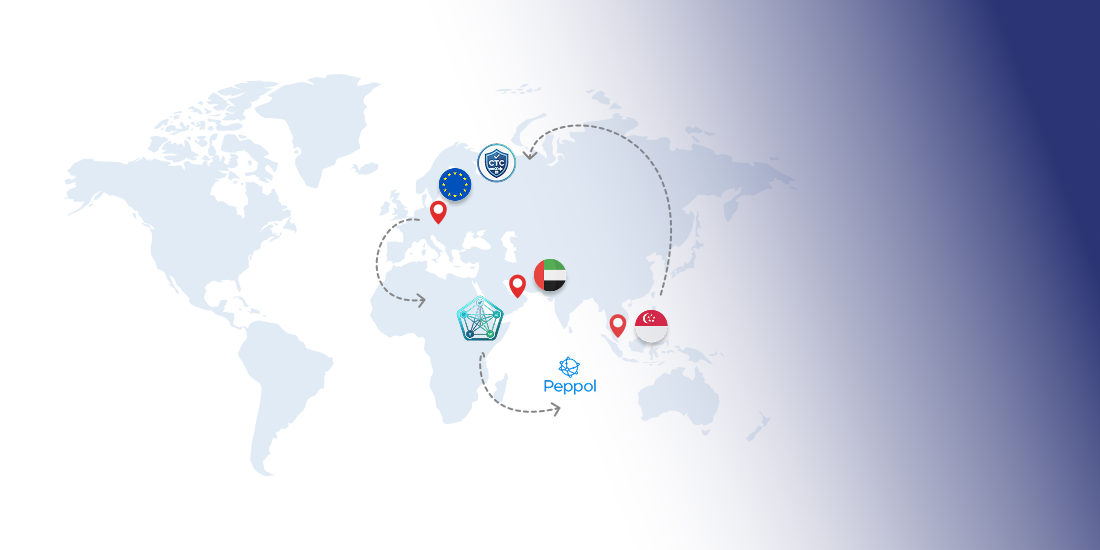
Global E-Invoicing Comparison: Singapore vs UAE vs EU Frameworks Explained (2026 Guide)
As governments worldwide accelerate digital transformation, e-invoicing has become a cornerstone of tax compliance and operational efficiency. However, in any global e-invoicing comparison, not all frameworks are created equal. Businesses operating across regions must understand how models differ—especially in key markets like Singapore, the UAE, and the European Union.
This global e-invoicing comparison is designed to help CXOs, tax leaders, and finance teams navigate regulatory complexity and prepare for what lies ahead. A well-structured comparison enables organizations to align their technology and compliance strategies with rapidly evolving requirements.
Singapore: InvoiceNow & the Peppol Model
Singapore’s e-invoicing system, InvoiceNow, is built on the Peppol network, enabling seamless and standardized invoice exchange between businesses. In any global e-invoicing comparison, Singapore stands out for its interoperability-first and business-friendly approach.
Key Features
- Decentralized 4-corner model
- Based on Peppol BIS standards
- Strong focus on interoperability and automation
- Ongoing initiatives to integrate with GST data reporting
What It Means
Singapore is taking an adoption-first approach—encouraging businesses to onboard before introducing stricter compliance requirements. This flexibility allows companies to connect once and exchange invoices with multiple partners without requiring custom integrations. As a result, Singapore is often viewed as a benchmark for interoperability in any global e-invoicing comparison.
UAE: Peppol-Based 5-Corner Model with Regulatory Oversight
The UAE is introducing a Peppol-based e-invoicing framework that incorporates a 5-corner model, adding a regulatory layer to enable real-time compliance and reporting. Within a global e-invoicing comparison, the UAE represents a structured, compliance-driven transformation.
Key Features
- Decentralized 5-corner model with tax authority oversight
- Integration with Accredited Service Providers (ASPs)
- Real-time or near real-time reporting capabilities
- Phased mandatory rollout expected (2026–2027)
What It Means
The UAE’s approach combines interoperability with regulatory control. Businesses will be required to transmit invoices through approved platforms, ensuring validation and reporting in line with tax authority requirements. This positions the UAE as a hybrid model in any global e-invoicing comparison, balancing efficiency with governance.
European Union: ViDA & the CTC Landscape
The European Union is evolving toward harmonized e-invoicing through the VAT in the Digital Age (ViDA) initiative, while individual member states continue to implement their own Continuous Transaction Controls (CTC) frameworks. In any e-invoicing comparison, the EU stands out as the most complex and mature environment.
Key Features
- Mix of clearance and reporting models across countries
- Real-time or near real-time reporting and/or validation (depending on jurisdiction)
- Country-specific mandates (e.g., Italy live, France upcoming, Germany roadmap)
- Long-term push toward EU-wide standardization under ViDA
What It Means
The EU requires businesses to navigate multiple compliance models simultaneously, from centralized clearance systems to decentralized reporting frameworks. This regulatory diversity makes the EU the most challenging region in any global e-invoicing comparison, while also setting the direction for future global standards.
Key Differences at a Glance
|
Aspect |
Singapore |
UAE |
EU |
|
Model |
Peppol (4-corner) |
Peppol (5-corner hybrid) |
CTC / Clearance / Reporting |
|
Approach |
Adoption-first |
Compliance-driven |
Regulation-heavy |
|
Reporting |
Evolving GST integration |
Real-time reporting expected |
Real-time / near real-time (varies) |
|
Complexity |
Low to medium |
Medium |
High |
|
Standardization |
High (Peppol-led) |
Developing |
Fragmented |
This table simplifies the global e-invoicing comparison, helping organizations quickly assess regional differences and implications.
Strategic Insights for Businesses
A global e-invoicing comparison reveals several critical trends shaping the future of compliance:
- Interoperability vs Control: Singapore prioritizes ease of exchange, while the UAE and EU emphasize regulatory oversight.
- Compliance Readiness: Businesses operating in the UAE and EU must invest early in scalable compliance frameworks.
- Scalability Matters: Global organizations need solutions that can adapt to multiple models simultaneously.
- Shift Toward Real-Time Reporting: Tax authorities are increasingly moving toward continuous transaction controls and real-time visibility.
These insights reinforce why a comparison is essential for long-term strategic planning.
Choosing the Right Approach
There is no one-size-fits-all solution in a global e-invoicing. Organizations must evaluate:
- Geographic footprint
- ERP and system landscape
- Transaction volumes
- Regulatory exposure
A flexible, ERP-agnostic solution can be a game-changer—especially for businesses operating across multiple jurisdictions with varying compliance requirements. Leveraging a global e-invoicing comparison enables more informed and future-ready decision-making.
How Anusaar Can Support
Anusaar, a next-generation e-invoicing platform, helps businesses navigate complex regulatory environments by offering a scalable, ERP-independent solution. Designed to support compliance across Singapore, the UAE, and EU frameworks, it enables seamless integration, regulatory readiness, and future-proof digital transformation—making it a strong enabler in any global e-invoicing comparison strategy.